The post Five Hands-on Activities to Celebrate National Bird Day appeared first on Project Learning Tree.
]]>1. Together for Birds
In PLT’s activity collection, Together for Birds, learners in grades K-5 investigate how birds and other living beings depend on their habitats to survive. From exploring the environment where birds live to channeling creativity and inspiration through poetry, these activities will spark curiosity and instill an appreciation for the natural world.
2. View Birds in Real Life
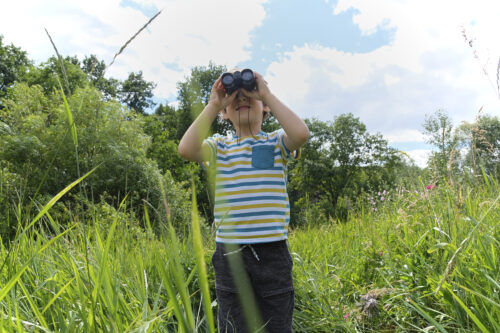
There’s no better way to learn about birds than to head outdoors and view them in real life! Bring binoculars and head into nature to spot birds in action. Don’t have binoculars? Have some fun making your own out of recycled materials (see “The Shape of Things” activity in PLT’s Trees & Me: Activities for Exploring Nature with Young Children).
Too chilly to head outside? Check out Cornell Lab’s Bird Cams, where you can watch live cams from all over the world. You can also download the Merlin Bird ID app from Cornell Lab to record birdsongs and upload photos that help identify the birds you’re hearing and seeing!
Here are some additional tips to get started with urban birdwatching!
3. Build Like a Bird
Birds are quite the engineers when it comes to building their nests! Go full S.T.E.A.M. ahead and encourage little learners to engineer the perfect bird nest using items you can find outside (and inside). Check out the “Tree Textures” activity in PLT’s Trees & Me guide for a how-to on making a nest. Take it one step further and make a yummy edible nest as a special treat – you can find the recipe in the “Home Tweet Home” activity from Trees & Me!
4. Play Bird Bingo
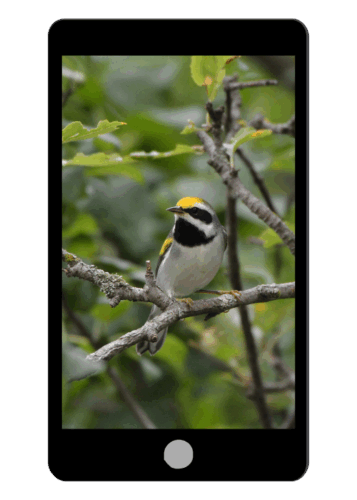
Print out these fun bingo cards and get ready to put your bird spotting eyes on!
5. Participate in the Great Backyard Bird Count
Every February, people around the world count birds in their neighborhoods to help scientists better understand and protect birds. Learn more about this annual event and how you can get involved.
More Ways to Learn
Check out these children’s books about birds from our Recommended Reading list:
Watch this webinar by American Bird Conservancy, Project Learning Tree, and North American Association for Environmental Education to learn how to begin environmental investigations using birds to hone the practices of observation, discovery, and reflection.
Looking for more hands-on activities to bring nature into the classroom or take learning outdoors? Find inspiration at www.plt.org.
The post Five Hands-on Activities to Celebrate National Bird Day appeared first on Project Learning Tree.
]]>The post Sustainably Managed Forests & Wildlife Conservation appeared first on Project Learning Tree.
]]>Now, think about our environment. If a forest is not managed properly, natural resources might become depleted and overused and ecosystems can get out of balance, leading to habitat loss, or invasive species.
That’s why sustainable forest management and conservation – defined as “a careful preservation and protection of something (especially: planned management of a natural resource to prevent exploitation, destruction, or neglect)- are so vital to the health of forest ecosystems, especially when forests are home to 80% of the world’s terrestrial biodiversity!
And it’s never too late to celebrate Wildlife Conservation Day (December 4)! You can help young people and the community better understand conservation through Project Learning Tree hands-on activities, like “Monitoring Forest Health” from Green Jobs: Exploring Forest Careers.
In this activity for older students, learners will explore just what goes into keeping forests healthy so the plants, animals, and insects that rely on these diverse ecosystems can thrive. It’s a great way for learners to see how soil scientists, wildlife biologists, foresters, and other natural resource professionals monitor forests and work together to create a forest management plan.
A forest management plan addresses any health issues and ensures the long-term sustainability of the forest. (Check out the “If You Were the Boss / Si Fueras el Jefe” activity from PLT’s Explore Your Environment: K-8 Activity Guide / Explora tu Ambiente: Guía de Actividades K-8 to learn more about all the factors and impacts considered when creating a plan.)
Wildlife conservation is a key piece of this multi-faceted plan.
Here’s an over-simplified example:
 Let’s say a massive forest fire came through an overly dense forest and destroyed 90% of the trees in a forested area. That equates to a significant loss of habitat for wildlife like birds, bats, raccoons, deer, and bears that rely on mature living trees for food and shelter. Some of those animals perished in the fire, while others were displaced. They may migrate to another nearby forest (or a heavily populated area), and now, that area has more animals than the habitat can support, and there is not enough food to go around.
Had that forest been better managed (i.e. controlled burning or thinning of overgrown stands), the fire might have been less devastating and could have been beneficialto wildlife by creating more shelter and boosting berry growth (like huckleberry!).
Had that forest been better managed (i.e., through controlled burning or thinning of overgrown stands), the fire might have been less devastating and could have been beneficial to wildlife by creating more shelter and boosting berry growth (like huckleberry!).
Sustainable forest management is an important way to retain and restore ecological balance that allows wildlife to thrive even in the face of catastrophes like wildfire.
Looking for more resources to learn about conservation, sustainable forestry, and our environment? Visit shop.plt.org to access Project Learning Tree’s hands-on instructional materials.
The post Sustainably Managed Forests & Wildlife Conservation appeared first on Project Learning Tree.
]]>The post See You at the 2026 Green Schools Conference! appeared first on Project Learning Tree.
]]>
Educators and students are shaping the future of education and green schools to build a more sustainable world. The Green Schools Conference, organized by the U.S. Green Building Council, is at the heart of this movement. It brings together educators, advocates, and professionals from across the country to advance green schools and sustainability in education.
This energizing two-day event will explore bold, practical solutions to advance green schools, focusing on environmental impact, health and well-being, sustainability literacy, and systemic change at every level of education.
With inspiring keynotes, expert-led sessions, hands-on workshops, and powerful networking
opportunities, GSC equips attendees with the tools, strategies, and community support needed
to lead the charge for healthier, more sustainable learning environments.
Explore Key Conference Themes:
- Environmental Impact: Strategies to conserve resources, reduce emissions, and restore ecosystems
- Health and Well-Being: Creating learning spaces that support the physical and
emotional health of students and staff - Environmental and Sustainability Literacy: Integrating systems thinking and placebased
learning across curricula - Whole School/District Sustainability: Embedding sustainability across culture,
operations, and education for long-term change
Coming together from across the country
The Green Schools Conference is the only national event that brings together people who lead, operate, build, and teach in U.S. green schools. That’s a big reason why I’m thrilled to represent Project Learning Tree and the Sustainable Forestry Initiative at the conference. I’m looking forward to connecting with people to learn from them and share PLT resources like our Green Schools Program, Forest Literacy Framework, and the K-8 Activity Guide.
Supporting Green Schools Nurtures the Next Generation
For me, supporting the green schools movement isn’t just about the physical infrastructure of a school—it’s also about nurturing the values of the next generation. By promoting green building practices, we can ensure that students are learning in spaces that not only inspire but also serve to protect the natural world.
Join me at the Green Schools Conference
Register for the Green Schools Conference today! A variety of registration packages are available, with special rates for employees of PreK–12 schools and districts, as well as government and non‑profit employees. I can’t wait to meet and talk more about how sustainably managed forests can benefit communities and kids!
The post See You at the 2026 Green Schools Conference! appeared first on Project Learning Tree.
]]>The post Celebrate the Holidays with Red Fir, Green Jobs, and the U.S. Capitol Christmas Tree appeared first on Project Learning Tree.
]]>In 2025, the People’s Tree is coming from the Silver State, AKA Nevada. When you think about Nevada, an arid, desert climate or the bright lights of Las Vegas might be the first things that come to mind. However, the Humboldt-Toiyabe National Forest, covering a whopping 6.3 million acres, is the largest national forest in the U.S. This massive forest spans the state and into eastern California.
This year’s Christmas tree, a 53-foot-tall red fir, will come from the Carson Ranger District in the heart of the Sierra Nevada mountain range. Fun fact: Red fir trees can grow from 80 to 150 feet tall.
Named the Silver Belle, this year’s tree represents the first time Nevada has had the opportunity to be the home state of the Capitol Christmas Tree. To celebrate, people from across the state have hand-crafted 10,000 beautiful ornaments that will adorn the tree, along with other trees inside the Capitol building.
Celebrate the U.S. Capitol Christmas Tree in your neck of the woods
 To help you celebrate, PLT created, in partnership with the USDA Forest Service, a free Activity Collection for those working with learners ages 10–16. The activity collection features four activities from PLT’s Learn About Forests and Explore Your Environment: K-8 Activity Guide, and highlights key facts about Nevada’s Humboldt-Toiyabe National Forest. You can also attend a PLT training, as some states in the tree route will be organizing themed workshops celebrating the U.S. Capitol Christmas Tree.
One of the most exciting things about the People’s Tree is the journey the tree takes to Washington, D.C. Want to catch a glimpse of the tree as it heads east? Here’s the schedule and route.
Schedule and Route
November 2 – Lovelock & Elko, NV
November 3 – Ely, NV
November 4 – Las Vegas, NV
November 7 – Flagstaff, AZ
November 8 – Albuquerque, NM
November 9 – Amarillo, TX
November 11 – Lenexa, KS
November 12 – St. Louis, MO
November 14 – Paducah, KY
November 15 – Lexington, KY
November 20 – Joint Base Andrews, MD
A holiday tradition since 1964
Massachusetts Senator John McCormack planted a 24-foot-tall Douglas fir on Capitol grounds in 1964. This was the first tree that started the ritual tree lighting on the West Lawn. Sadly, the tree died after three years from wind and root damage. In 1970, the Monongahela National Forest supplied the first People’s Tree.
Today, Jim Kaufmann, Director of the Capitol Grounds for the Architect of the Capitol, chooses the People’s Tree. The USDA Forest Service assesses the environmental impact of harvesting the tree by investigating if the tree is close to any endangered species or water sources and if it provides shelter for wildlife.
Green jobs key to delivering holiday magic
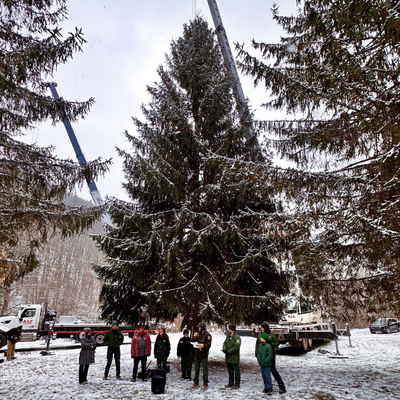
Dozens of people working in forestry and other green jobs are responsible for making this wonderful holiday tradition happen.
“Green jobs represent a wide diversity of career paths for people. From surrounding yourself in nature as a forester, getting your hands dirty as a soil scientist, or exploring the tech side of green jobs as a GIS specialist, there is literally something for everyone. It’s great to see the Society of American Foresters talk about working in forestry and other green jobs as part of their US Capitol Christmas Tree Forestry FAQs,” said Josh Brankman, PLT VP Education.
The SAF FAQ describes how green jobs offer a wide variety of career opportunities based on interest areas and skill sets. Green jobs include positions like foresters, park rangers, wildland firefighters, wildlife biologists, policymakers, public outreach professionals, recreation managers, loggers, and lumber mill workers. Jobs can be seasonal or full-time in both indoor and outdoor settings.
“We were also really pleased to see SAF reference Project Learning Tree’s Green Jobs: Exploring Forest Careers guide. It features four hands-on, minds-on activities to help young people learn about forestry jobs and practice managing and monitoring forest resources,” said Brankman.
The growth of green jobs has outpaced jobs in other employment categories by almost 250% over the last decade. Green jobs are defined by the Bureau of Labor Statistics as jobs that produce goods or services that benefit the environment or conserve natural resources, or jobs that use more environmentally friendly processes or fewer natural resources.
Tools, info, and activities to learn about green jobs
PLT activities also include details about different green jobs. It’s our goal to introduce students to the green job possibilities out there, and we’d love your support!
Explore green jobs that support forests and learn more about career readiness supports through PLT. You can also take a one-time free trial of the PLT Green Jobs Quiz.
For additional inspiration, get a copy of Black Faces in Green Spaces: The Journeys of Black Professionals in Green Careers.
The post Celebrate the Holidays with Red Fir, Green Jobs, and the U.S. Capitol Christmas Tree appeared first on Project Learning Tree.
]]>