The post Sustainably Managed Forests & Wildlife Conservation appeared first on Project Learning Tree.
]]>Now, think about our environment. If a forest is not managed properly, natural resources might become depleted and overused and ecosystems can get out of balance, leading to habitat loss, or invasive species.
That’s why sustainable forest management and conservation – defined as “a careful preservation and protection of something (especially: planned management of a natural resource to prevent exploitation, destruction, or neglect)- are so vital to the health of forest ecosystems, especially when forests are home to 80% of the world’s terrestrial biodiversity!
And it’s never too late to celebrate Wildlife Conservation Day (December 4)! You can help young people and the community better understand conservation through Project Learning Tree hands-on activities, like “Monitoring Forest Health” from Green Jobs: Exploring Forest Careers.
In this activity for older students, learners will explore just what goes into keeping forests healthy so the plants, animals, and insects that rely on these diverse ecosystems can thrive. It’s a great way for learners to see how soil scientists, wildlife biologists, foresters, and other natural resource professionals monitor forests and work together to create a forest management plan.
A forest management plan addresses any health issues and ensures the long-term sustainability of the forest. (Check out the “If You Were the Boss / Si Fueras el Jefe” activity from PLT’s Explore Your Environment: K-8 Activity Guide / Explora tu Ambiente: Guía de Actividades K-8 to learn more about all the factors and impacts considered when creating a plan.)
Wildlife conservation is a key piece of this multi-faceted plan.
Here’s an over-simplified example:
 Let’s say a massive forest fire came through an overly dense forest and destroyed 90% of the trees in a forested area. That equates to a significant loss of habitat for wildlife like birds, bats, raccoons, deer, and bears that rely on mature living trees for food and shelter. Some of those animals perished in the fire, while others were displaced. They may migrate to another nearby forest (or a heavily populated area), and now, that area has more animals than the habitat can support, and there is not enough food to go around.
Had that forest been better managed (i.e. controlled burning or thinning of overgrown stands), the fire might have been less devastating and could have been beneficialto wildlife by creating more shelter and boosting berry growth (like huckleberry!).
Had that forest been better managed (i.e., through controlled burning or thinning of overgrown stands), the fire might have been less devastating and could have been beneficial to wildlife by creating more shelter and boosting berry growth (like huckleberry!).
Sustainable forest management is an important way to retain and restore ecological balance that allows wildlife to thrive even in the face of catastrophes like wildfire.
Looking for more resources to learn about conservation, sustainable forestry, and our environment? Visit shop.plt.org to access Project Learning Tree’s hands-on instructional materials.
The post Sustainably Managed Forests & Wildlife Conservation appeared first on Project Learning Tree.
]]>The post Elevating Indigenous Knowledges in Environmental Education: Why it Matters and How to Start appeared first on Project Learning Tree.
]]>As a student growing up in a small farming community in Minnesota, I didn’t look like the other students in my class, nor did I look like the teachers around me. I was often called out by teachers whenever the topic of ‘Native Americans’ came up in class and often ridiculed (by staff and students alike) for being different. While things have improved in many respects, the reality is that for most Indigenous students in North America in the public school system, they’re likely to complete their primary and secondary education without ever having a teacher who looks like them or shares the same cultural background or perspectives and they often still experience the same kinds of problematic tokenism and harassment that I did over 20 years ago.
More and more Indigenous people are pursuing degrees in education and helping to address this gap, but non-Indigenous teachers can also help by incorporating ITECK into their lessons and elevating Indigenous knowledges in–and out of–the classroom. The inclusion of Indigenous knowledges in lessons helps to destigmatize traditional knowledge, helps promote sustainable land stewardship and use practices, and acknowledges its value and contributions to the world of science.
This is not an easy thing to do! And the difficulty of doing it–and doing it in a culturally responsive way–is the biggest challenge to being more inclusive. After nearly seven years in formal and informal education advocating for the inclusion of Indigenous knowledges in every subject, I hope to be able to share some helpful suggestions to start you on your path towards elevating Indigenous knowledges in the work you do.
How to Get Started
Learn
 Who are the Indigenous Peoples around you today, and who were they historically? The history of colonization globally has left few Indigenous communities untouched, and although its impacts vary greatly, some of its defining characteristics include the dispossession of traditional lands, forced assimilation through ‘education,’ the criminalization of traditional language, cultural practices, and religion, and vast population reduction as a result of disease exchange. However, Indigenous Peoples are still here–they are resilient, thriving, contemporary peoples with their own stories and knowledges to share. So, do some research about your local Indigenous communities through their sources: tribal websites, tribal museums, community authors, and speakers.
I encourage my students to utilize the Native Land Digital website to learn more about where Indigenous Peoples are and have been located and treaty history. Through this deep dive into your local Indigenous communities, you will hopefully be able to find some resources–even community members!–to draw on to be more inclusive.
Connect
Relationship building is central to working with Indigenous Peoples. The first step in this process can be attending community events open to the public, such as powwows, feasts, and other cultural celebrations. If you’re unsure how to do this respectfully, this resource can help! Introduce yourself to some folks and make connections to show you are committed to the inclusion you hope to foster. Reach out to community members who are already doing similar work and start a conversation about how you can collaborate to achieve similar goals. This step is often the hardest for people because it’s difficult to be vulnerable: we don’t want to offend people, so we hesitate even to start a conversation to avoid this. However, we can never move on to the collaboration if we don’t start the conversation.
Ask
It’s completely normal to feel uncomfortable incorporating Indigenous knowledges into your lessons if you are non-Indigenous. When done respectfully and with the input of community, you eventually get over this. But, in the meantime, lean on your relationships and ask community members who are knowledge holders to step into that place of sharing if they are comfortable doing so. Key to this is honoring that knowledge sharing appropriately through gifting and/or compensation: in many Indigenous communities in North America, a small gift of tobacco is a sign of respect and gratitude to a community member who has agreed to share knowledge. Other small gifts- homemade jelly or jam, a coffee mug, a book–are also appreciated. Whenever possible, consider monetary compensation to offset travel costs and the time the individual has given you and your students. Whether a gift or monetary compensation, it is appropriate to ask the individual if they have a specific request to ensure you meet their expectations.
Collaborate
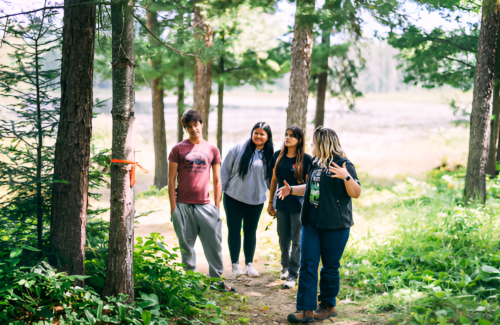 Work with community members to incorporate Indigenous knowledges into your lessons in a culturally responsive and appropriate way. This can include having community members directly contribute to the writing of lessons or reviewing lessons after they have been written to ensure they are appropriate. Consider how these lessons can benefit not just your own students. Making lessons open-access and sharing with others:
- widely increases awareness
- improves representation for Indigenous students
- opens the door for other educators to be more inclusive in their own work, and
- increases the positive impact of elevating Indigenous knowledges.
In this step, always consider permissions: do you have permission from the knowledge holder to share what you are, in the way you are? Even when something is published, it’s a good idea to ask permission again to use that information differently than it was originally intended.
If you are working with PLT lessons as a base, I find that it’s particularly easy to adapt the 400 Acre Wood lesson from the PreK-8 Environmental Education Activity Guide (If You Were the Boss in the Explore Your Environment: K-8 Activity Guide) to reflect local fauna, especially those that are particularly important to the local Indigenous Peoples of your region, giving you the opportunity to bring in discussions of relationships with animals and Indigenous language use through the incorporation of traditional words for animals.
Return
Return the favor AND again and again!
What do you have to offer the community you now have a relationship with? How can you share your knowledge to benefit the goals of that community? How can you support the work that they are prioritizing?
Be there, return the favor, and do it again and again and again. This kind of work is not a one-off: relationship building is a lifelong process, a commitment to support, share, and care for one another. Encourage the growth and deepening of the relationships you have built in the community through continued conversations and collaboration in the years to come. Careers shift; people move. If you stay close enough to these communities you have been working with, consider how to continue that work and stay in relationships. And if it’s not possible, think about how you can foster the development of a relationship between a colleague and that community to continue the collaboration in your place.
I won’t pretend this work is easy, quick, or always successful. Communities don’t always say yes, relationships don’t always pan out, and these things always take longer than you hope they will (and often longer than the timeline a funder has given you to do it!). But, if you’ve decided this is meaningful to you, your students, and your community, missteps are part of the process; they help you learn along the way. I can promise that the first time you teach a culturally responsive lesson to your students and you see the smile and pride that radiates from the ‘one Native kid’ in the group, it will all be worth it.
Additional Resources
- Beyond Conservation: Working Respectfully with Indigenous People and Their Knowledge Systems
- Indigenous Knowledges and Perspectives on Climate Adaptation
- 7 Tips on Building Relationships with Indigenous Peoples
- How to Build Good Relations with Indigenous Peoples: An Interview Series (Part 1)
- Collaboration is Key to Indigenous Relationships
Editor’s Addition: Native American Heritage Month, Thanksgiving, and Year-Round Resources for Educators
 The Sustainable Forestry Initiative (SFI) and Project Learning Tree (PLT) are committed to continuing our own education and establishing mutually respectful relationships with Indigenous Peoples (also known as reconciliation) through our work. We’re passionate about providing resources to create a better understanding of the importance of forests and the many communities that rely on forests for the spiritual, cultural, environmental, and economic benefits they bring. We’ve compiled a non-exhaustive list of resources for educators to help you get started or continue your personal and your students’ learning journeys. The best resources are those developed by Indigenous peoples, themselves. Other representations of Indigenous Peoples and/or the language used can be imperfect, so we encourage you to consider those a starting point to be researched and reflected upon.
The post Elevating Indigenous Knowledges in Environmental Education: Why it Matters and How to Start appeared first on Project Learning Tree.
]]>The post People of PLT | Getting to Know a True Force of Nature appeared first on Project Learning Tree.
]]>
Have you ever met someone who just has that “It factor”? Someone with a magnetic personality, who’s warm, friendly, fun to be around, and draws in everyone around them.
If you haven’t noticed, the Project Learning Tree network sure has a lot of shining stars from educators inspiring learners through PLT activities to amazing facilitators leading PLT professional development events. But at the heart of our network are our PLT State Coordinators. These are the rockstar individuals leading PLT within their state, sharing their passion for nature-based education and introducing young people to the environment.
This month, we’re getting to know our Oklahoma PLT State Coordinator, Tony Pascall. Tony is the Education Coordinator for Oklahoma Forestry Services where he not only juggles multiple projects, but in his spare time he’s teaching himself how to actually juggle! “I’m up to 25ish catches in a row!”
Before becoming a PLT State Coordinator three years ago, Tony taught middle school math and STEM in Title 1 schools in Detroit and Dallas for several years. After graduating with a degree in Ecology from North Carolina State, he joined Teach for America with the intention of going back to become a plant biologist.
But instead, he caught a bug—the teaching bug—and fell in love with it. “The entire time I worked to incorporate my love of nature and the outdoors into my teaching. I brought my students outdoors for math labs, and even had an outdoor adventure club, where I brought some students hiking and camping! Most of my favorite moments in my formal teaching career come from this club, where I got to watch students fall in love with – and ultimately to learn to conserve – their environment.”
It’s all about the people
PLT isn’t just professional development and environmental education resources. It’s also a community of people passionate about educating the next generation and encouraging students to think broadly and dream big. “The environmental education community is very welcoming, and I love how much everyone reaches out to help one another. I’ve been able to work with several different organizations to put on shared educator workshops and student events, and every time I meet new people and learn something new.”
And the best place to meet these awesome people? A local PLT professional development event, that’s where! Tony’s favorite thing about these events is “Meeting cool educators! I love seeing what other folks are up to, how they already incorporate nature education into their teaching, and showing off PLT’s awesome standards-aligned activities. We always generate great ideas to adapt activities for different folks, and there is an awesome spirit of collaboration at PD events.”
Tony is all about creating a welcoming space for educators and students alike. And his local community recognizes his commitment and dedication for doing so. Earlier this summer, Tony was named as the 2024 Informal Science Teacher of the Year by the Oklahoma Science Teaching Association.
 Give space for nature
We always like to ask our People of PLT what suggestions they have for educators on how to incorporate PLT into their lessons. Tony shared some great advice at a workshop earlier this year with a group of middle school teachers. He said, “‘You can’t teach awe and appreciation for nature, but you can give space for it.’ They put it on the back of their camp t-shirts this year! I think PLT can help teachers build in more time for understanding of the world around them in their classes. My advice is to slow down and let there be time to notice.”
Start with one activity
Back in Tony’s classroom days, he loved using the outdoors as a way to get students more interested in the material he was teaching. “When I taught 7th grade math, I used to say, “You can draw a graph about anything!” I chose to teach outdoors and about our environment because my students were usually more engaged and more curious when learning about the natural world.
If you’re able to take your students outdoors safely, start small and try one lesson outside. See how things go and as you become more comfortable, increase outdoor time to once a month or once a week. “I believe everyone deserves to understand and love their place. I think that once you get kids looking closely at what is right outside their door, they quickly get curious and start asking questions and making connections.”
Teach language arts? Try the “Poet-Tree” activity from the Explore Your Environment: K-8 Activity Guide and encourage your students to get creative while writing about nature. Teach math? Collect, analyze and graph bugs you collect in the schoolyard during the “Birds and Bugs” activity from the K-8 guide. Whatever subject you’re teaching, there is a PLT activity you can do that uses nature as a learning tool.
Tony’s favorite PLT activity is “If You Were the Boss” from Explore Your Environment and Green Jobs: Exploring Forest Careers. “I love that the kids can make choices, then see how what they decided effects things like wildlife, how many trees are cut down, and how much money they will need to spend. I like giving everyone a chance to revise their choices if they didn’t like the outcomes the first time through. I think it gives kids a cool sense of agency.”
Get connected
Want to get meet other educators using PLT in your state? Interested in learning more about becoming a PLT facilitator to lead professional development events? Visit plt.org/yourstate to get connected with your local PLT Coordinator.
The post People of PLT | Getting to Know a True Force of Nature appeared first on Project Learning Tree.
]]>The post This Woman’s Place is in the Forest appeared first on Project Learning Tree.
]]>
Every March, we celebrate two special days – International Women’s Day and International Day of Forests. We’re excited to highlight Brenda Haskill, who has shared her story of being a woman working for the woods.
I’m lucky to have developed an early love for the forest.
I was raised in a logging family, and my mom started driving the logging truck for our business when I went to kindergarten. Every time I smell fresh-cut wood, see sawdust and hear a diesel engine while out on a harvest site in the forest, I am transported back to those early years.
It never occurred to me as a child that there were perceptions about what women could not or should not do as a career. Reality set in during college. When I attended Michigan Technological University in the late 1980s to obtain a Bachelor of Science degree in forestry, there were five women and around 35 men in the program.
Unfortunately, diversity has not expanded much in the past 30 years of my career, and the percentage of women and minorities in forestry is still sadly low. As of 2019, women represented just 16% of forestry and conservation professionals in the United States, according to the Society of American Foresters.
When people find out I’m a forester, I often get asked if I’m a “ranger.” In most of North America, a ranger is a person we meet at our parks and campgrounds who helps care for the facilities and assures we all enjoy our time spent at them.
Since I’m not a ranger, the next question is, “So, what’s a forester?”
Foresters care for and manage forests and trees to suit desired outcomes.
We are urban foresters, consulting foresters, state government foresters, and more. We have a deep love for trees and the forested landscape.
Traditional foresters manage tracts of land with specific goals. Sometimes, that’s to provide a haven for wildlife. Other times, it’s for timber production to create income opportunities. On other occasions, it’s to help the forest be as healthy as possible. We also often manage for a mixture of all those outcomes, depending on who owns the land.
Just like other professions, there are various branches (pun intended) of forestry.
 When my career began, if you studied forest management, you were a forester. Foresters can now study ecology, ecosystems, environment, hydrology, engineering, and many more specific courses of study.
Working as a woman in forestry has difficult days. Even now, I am occasionally mistaken for a secretary and asked if male colleagues could better talk about the issues at hand.
But as I walk into meetings with a hard hat and 30 years in my profession, I enjoy watching the faces of sawmill owners and loggers as I share my experience and discuss industry specifics like lumber thickness, logging site complications, and trucking issues.
Their surprise at my expertise turns to curiosity and then to acceptance as they enjoy discussing the finer points of the forest industry with me.
Gender diversity is slowly growing in the sector, due in part to the efforts of groups like the Women’s Forest Congress and Women Owning Woodlands (a former Sustainable Forestry Initiative [SFI] grant recipient), both formed during the last several years.
The ownership of North American forests is shifting to include more women. Agencies and landowners are searching for women foresters to connect with and learn from as they own and manage their own forestland. The need for women foresters is growing every year.
We all have those days that make us question our career paths, but it’s easier to turn those days around when you’re spending time in the relaxing, deep cool green of a forest – and you get paid to do it.
We hear a great deal lately about forest bathing and how good it is for us to spend time outside, immersed in any part of nature. Just 15 minutes a day at your local park spent sitting under a tree, looking at a pond, or listening intently to birdsong provides numerous short and long-term mental and physical health benefits.
A career in natural resources can be the most rewarding path chosen because, as John Muir once wrote, “Into the forest I go, to lose my mind and find my soul.”
A day in the forest can quiet the mental noise in our brains and enrich our souls with all that surrounds us.
Learn more about green careers in forestry and conservation
- Read more stories from Michigan Department of Natural Resources employees and partners like Brenda at Michigan.gov/DNRStories.

- Discover green jobs best suited to your personality with Project Learning Tree’s free trial of the Green Jobs Quiz at plt.org/GreenJobsQuiz.
- The Green Jobs guide is the perfect tool to help young people ages 12-25 learn about green jobs in forestry and natural resource management in settings ranging from community youth programs and school classrooms to college and career prep, as well as field trips and forest tours.
- Explore types of green jobs and their many individual and collective benefits, browse free resources, and assess your STEM (science, technology, engineering, and mathematics) skills at org/WorkingForForests
- Check out SFI’s Chief Sustainability and Diversity Officer, Bettina Ring’s video celebrating the many contributions of women in forestry and natural resources conservation for International Women’s Day.
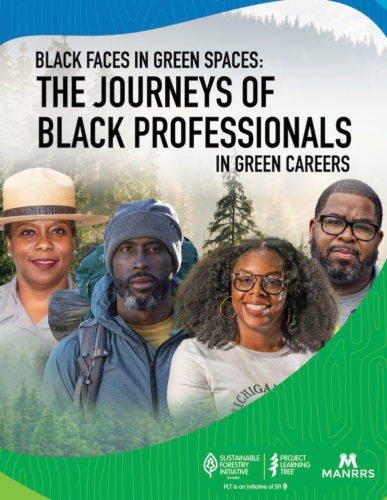
- The forest sector continues to struggle with workforce diversity, with a recent U.S. Census Survey finding that less than 3% of foresters and conservation scientists identify as African American. Help young Black Americans discover opportunities for rewarding careers in forestry and conservation with the Journeys of Black Professionals in Green Careers guide.
- Mentorship creates opportunities to share tips and resources, transfer skills, and boost the confidence of mentees and mentors alike! It’s important to support increasing mentorship opportunities for natural resource professionals and environmental educators, especially for women and young people from underrepresented communities. Learn more about how the PLT Green Mentor program connects young people ages 18-30 with green professionals across Canada and the United States to support the next generation’s efforts to build their forest and conservation knowledge and career goals—and gain new perspectives while you network!
Editor’s note: A version of this story originally appeared in the October 2022 weekly story series Michigan.gov/DNRStories published by the Michigan Department of Natural Resources.
The post This Woman’s Place is in the Forest appeared first on Project Learning Tree.
]]>