The post Jina Jeong: Project Nature appeared first on Project Learning Tree.
]]> Jina Jeong: Project Nature
Grades K-3
Written by: Carol Kim
Illustrated by: Ahya Kim
ISBN: 978-1-4846-7964-7
Recommended Reading
We all know what the research says…time spent in nature is good for you! In the book, Jina Jeong: Project Nature, a young girl named Jina comes to this realization when she’s out for a hike with her family. Unfortunately, upon visiting the nature center, she learns that many children don’t have access to parks and have never been hiking or camping.
This lights a fire in her belly to help more children spend time in nature. Jina dreams of starting a nature club for kids in her city.
Start Small
To achieve big things starts with taking small steps, and Jina’s parents recommend she begin by introducing one friend to the outdoors and growing things from there. Jina identifies fun activities that she thinks will appeal to her friend during their camping trip, like making leaf rubbings and going on a nature scavenger hunt.
While everything didn’t quite go as planned on their trip, Jina and her friend made the best of everything. It took introducing just one person to nature to spark their curiosity and interest! Together they plan to introduce even more friends to the environment.
PLT Activities
This book is a good read-aloud to younger children and a great option for newer chapter book readers. Not only do kids learn about all the fun things you can do in nature, but it’s a wonderful way to encourage learners to take action and be leaders among their peers.
Consider pairing Jina Jeong: Project Nature with activities from PLT’s Connecting for Health and Planet digital activity collection. Students investigate how being outside provides people with many different physical, emotional, social, and learning benefits.
You can also get creative in “The Closer You Look / Entre Más Cerca Veas” from Explore Your Environment: K-8 Activity Guide / Explora tu Ambiente: Guía de Actividades K-8 by doing leaf and bark rubbings while exploring the structure of a tree. Or go on a nature scavenger hunt like Jina and her friend did and play Tree Observation Bingo in “Trees as Habitats / Los Árboles como Hábitats”, also from Explore Your Environment / Explora tu Ambiente.
For older learners, this book might spark an interest in careers where you can work in the forest. Introduce students to different jobs through the “My Green Future/Mi Futuro Verde” activity from Explore Your Environment / Explora tu Ambiente.
The post Jina Jeong: Project Nature appeared first on Project Learning Tree.
]]>The post Take a Gratitude Walk appeared first on Project Learning Tree.
]]>Which is why right now is the perfect time to refuel and recharge yourself (and your learners) by taking a Gratitude Walk.
A Gratitude Walk helps us pause, reflect, and give thanks for every person and every living thing in our natural world.
While Indigenous Nations across North America differ in many ways, one commonality they share is that other beings, not just humans, are considered our relatives in the web of life. This is not only honoring and showing respect to one another but also to the plants, animals, insects, water, and other sources of life on our planet. We are all interconnected and rely on each other.
A Gratitude Walk helps remind us of this.
Give Thanks
Research has shown that expressing gratitude and spending time in nature benefits your mental and physical health. According to UCLA Health, “Taking a moment to be thankful causes physiological changes in your body that initiate the parasympathetic nervous system—the part of your nervous system that helps you rest and digest. Gratitude and the response it causes help bring down your blood pressure, heart rate and breathing to help with overall relaxation.”
Being in nature has similar effects—reducing anxiety and stress levels and boosting creativity and the ability to problem-solve.
Pause & Reflect
A Gratitude Walk is something that learners of every age can do.
Whether you can take learners outside for 5 minutes or 50 minutes, grab a sweater or warm coat and head into nature for a walk.
 Begin your walk by modeling a slow pace and quiet mind, allowing for time to simply notice. Encourage everyone to use their senses, which might entail closing their eyes momentarily to fully be immersed in listening.
- Notice the sounds you hear. Are leaves rustling in the wind? Do you hear birds chirping? How do the sounds make you feel? Can we thank the wind and birds for their gifts of nature noises?
- Take a deep breath in and notice the smells. Can you smell pine needles? What about crisp, fresh air? Do you smell freshly cut grass? Let us thank the trees and plants for providing sweet scents and clean air for us to breathe.
- What is the weather like? Is it chilly? Is the sun shining warmly on your face, or is there a cool mist falling from the fog? Let us thank the sun for feeding the plants and the rain for bringing us water. Let us be grateful to the four seasons and variety of weather each season provides.
- Can you spot any animals or insects? Let us be grateful to the animals and insects that help pollinate the plants we eat or who bring us delight when we spot them.
Allow an opportunity for your learners to walk quietly and think about what they are grateful for and, if you have time, invite everyone to share or express that gratitude aloud.
Nature is teeming with life!
Invite your learners to point out as many living beings as they can. Together, talk about the role each plays in the web of life. Encourage learners to express their gratitude for each thing they notice, including one another.
Find a plant or tree that each person can get close to and explain how plants give us fresh oxygen, and in return, they breathe in the carbon dioxide that we are breathing out. Demonstrate that we can share our gifts with each other in a circle of reciprocity – take a moment to lean toward the plant and deeply breathe in the fresh air, then, in return, breathe out onto the plant. We can express our gratitude when we share our gifts with each other. This also allows for an opportunity to take a few deep, calming breaths in nature.
Even if you can’t go for a long walk, just spending a brief time sitting outdoors to reflect and give thanks to each other and our natural world can make a world of difference during this season, which can be stressful.
PLT Activities to Pair with a Gratitude Walk
Early Childhood
- Any and all activities from Trees & Me: Activities for Exploring Nature with Young Children
Elementary & Middle School
- Get Outside! / ¡Sal al Aire Libre! from Explore Your Environment: K-8 Activity Guide / Explora tu Ambiente: Guía de Actividades K-8
- Poet-Tree / Árbol Poeta from Explore Your Environment: K-8 Activity Guide / Explora tu Ambiente: Guía de Actividades K-8
- Web of Life / Telaraña de la Vida from Explore Your Environment: K-8 Activity Guide / Explora tu Ambiente: Guía de Actividades K-8
- Connecting for Health and Planet activity collection
High School
- Words to Live By from Focus on Forests
- Personal Places from Places We Live
Learn More
You can find additional details about Traditional Knowledge and Gratitude Walks in Appendix F of PLT’s Trees & Me: Activities for Exploring Nature with Young Children.
Thank you to Molly Gillespie, Alaska PLT State Coordinator, for contributing to this article!
The post Take a Gratitude Walk appeared first on Project Learning Tree.
]]>The post PLT’s Newest Activity Collection: Connecting for Health and Planet appeared first on Project Learning Tree.
]]> Project Learning Tree recently launched a new theme-based activity collection!
The Connecting for Health and Planet Activity Collection is our latest release featuring three PLT activities for educators of students ages 8-11 and grades 3-5. And if you work with older students, the activities also contains age-appropriate adaptations for educators working with grades 6-8.
Designed to be flexible, the activities can be used as stand-alone lessons, or all together as a cohesive unit of instruction using a storyline technique.

Connecting for Heath and Planet: Grades 3-5 Activities
The three downloadable activities were developed with support from Nice-Pak and invite students to investigate how being outside—and among trees, specifically—provides people with many different physical, emotional, social, and learning benefits:
-
- Get Outside!: Students investigate the physical and emotional benefits of working or playing outside.
- Poet-Tree: Students explore the benefits of being outside as they make observations of how trees make them feel. This activity also incorporates traditional knowledge with a gratitude walk.
- Helping Hands: Students plan and carry out a project to improve a shared, local outdoor space.
How do trees connect with human and environmental health?
A growing body of research confirms that children are healthier, happier, more creative, and have better knowledge retention when they consistently play and learn outdoors. Some benefits of time outdoors for youth include:
- Increased attentiveness and better recollection of information, even after they go back inside.
- Improved performance on tests and other external measures of knowledge gains.
- Greater feelings of competence and motivation to learn.
- Elevated mood and better ability to regulate emotions.
- Decreased stress and anxiety.
- More physical activity and improved physical health.
- Improved balance, coordination, and problem-solving skills through less structured play.
- More frequent and more effective conflict management, communication, and peer cooperation.
While much of the research focuses on children, there is also evidence that being outdoors is good for adults as well. Plus, an additional benefit of spending time outdoors is an increased investment in these places and spaces by the people who experience them.
Learning Progressions
Storylines provide connectedness and continuity to individual activities and can serve as the instructional glue that holds areas of knowledge and skills together. The activities in Connecting for Health and Planet may be linked together into a unit of instruction using a storyline technique, such as the one that follows.
Guiding Question: How does being outside benefit people?
Storyline: Being outside and among trees provides people with many different physical, emotional, social, and learning benefits.
The sequence of individual activities supports this storyline:
1. Get Outside!
Investigate the physical and emotional benefits of working or playing outside; encourage students to design and plan the investigation and analyze their results.
2. Poet-Tree
Explore the benefits of being outside and make observations about how trees make us feel. Invite students to gather “tree impressions” and to use these impressions to write poems centered around trees.
3. Helping Hands
Challenge students to describe the feelings a local area evokes and what they wish were different about it. Plan and carry out a model project to improve the site, and reflect on the environmental, community, and personal benefits of the project.
New Features Within Each Activity
In addition to the typical elements that educators have come to rely on from PLT, the following new features in our theme-based series will further help educators adapt the activities for specific groups and settings.
Academic Standards
Classroom educators and nonformal educators alike need to ensure that instruction helps diverse learners meet rigorous academic benchmarks. Each PLT activity displays explicit connections to practices and concepts mandated by the following national academic standards. Here’s an example from the first activity in the collection, Get Outside!:


Take It Outside!
Describes how to extend student learning into the outdoors.

Differentiated Instruction Strategies
-
-
- Cooperative Learning
- Literacy Skills
- ELA Skills
- Hands-On Learning
- Higher-Order Thinking
- Multiple Solution Pathways
- Nonlinguistic Representations
- Personal Connections
- Student Voice
-

Did You Know?
Forest Facts present interesting insights into forests as global solutions for environmental, economic, and social sustainability.

Career Corner
Introduces youth to forest-related careers.
Purchase Connecting for Health and Planet now from PLT’s Shop for $5.95
Like what you see? Check out our other low-cost, downloadable activity collections:
- Sensational Trees for grades K-2
- Biodiversity Blitz for grades 3-5
- Trillions of Trees for grades 3-5
- Nature of Fire for grades 6-8
- Discover Your Urban Forest for grades 6-8
This collection is supported by Nice-Pak.
The post PLT’s Newest Activity Collection: Connecting for Health and Planet appeared first on Project Learning Tree.
]]>The post STEM: Get Outside appeared first on Project Learning Tree.
]]> Have you ever sat quietly in a familiar place and listened to the sounds, breathed in the smells wafting through the air, or used your sense of touch to feel the different textures of everything around you? We use our senses (sight, smell, touch, sound) every second we are awake, but have you ever thought about using them as part of an experiment? This activity allows you to use your senses and count, or quantify, how things change from one place to another.
These enrichment ideas accompany the Get Outside! activity found in Project Learning Tree’s Explore Your Environment: K-8 Activity Guide. Be sure to check out the full activity!

Essential Question: In what ways can scientific research be applied both indoors and outdoors?
Task: Use these experiences to:
- Enhance skills in writing scientific questions
- Explore software tools for organizing and analyzing data
- Apply design thinking skills to the creation of a new product
- Collect quantitative data using sensory experiences
NGSS Connections:
- 3-5-ETS1-2: Engineering Design – Generate and compare multiple possible solutions to a problem based on how well each is likely to meet the criteria and constraints of the problem.
- 5-ESS3-1: Earth’s Systems – Obtain and combine information about ways individual communities use science ideas to protect the Earth’s resources and environment.
STEM Strategies
Science:
A scientist is someone who systematically gathers and uses research and evidence to make hypotheses and test them to gain and share understanding and knowledge. Scientists must be able to construct good scientific questions. Good scientific questions are ones that can be answered by an experiment and typically begin with words such as “What,” “How,” or “Why.” A question that can be answered with a simple “yes” or “no” is not a good scientific question.
Use this short guide to Asking Good Scientific Questions from the University of Kentucky’s College of Agriculture, Food, and Environment to develop your skills in developing good scientific questions.
Technology:
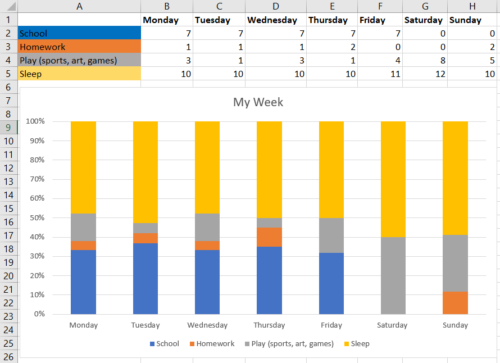
Data collection is an important part of being a scientist. Scientists use computer software tools to be more efficient and to reduce errors. Scientists create spreadsheets using software like Microsoft Excel to organize data in rows and columns and then analyze and categorize the data based on their needs.
Here’s an idea for collecting your own data: For each day of a week, record the number of minutes you sleep, play, and study. Place the days of the week across the top (in the lettered column headings) and your activities, such as sleep, play, and study down the left side (in the numbered rows). Track and record your data daily. To create your own data set in a software program like Microsoft Excel, open a “blank workbook” and begin entering your data. Try using different types of charts to create a visual representation of your data. See example below.
Don’t have access to Microsoft Excel? No problem! Try one of the following free online programs to organize and manipulate your data using spreadsheets:
Engineering:
Have you ever wished you could bring elements of the outside indoors and vice versa? As you might have guessed, many market-based products are designed to do just this! For example, an air freshener might make your room smell like a forest or meadow (bringing the outside to the inside), and exercise videos can now virtually transport you to another place (bringing the inside to the outside).
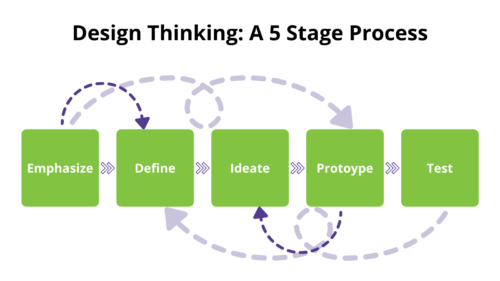
Challenge yourself to make two lists:
- A list of things you would like to bring from the outside to inside your home (or classroom), and
- Another list of things you would like to bring from inside your home (or classroom) into the outdoors.
Think about how you might accomplish at least one item on either list. Use elements from the Design Thinking Process to design your own product that could make it happen.
Math:
Mathematics is used in science to calculate the measurements of objects and their characteristics, as well as to show relationships between different functions and properties. Scientists can work both inside and outside and also use many math skills. Let’s practice using math in a scientific setting where we collect data points from different locations, both indoors and outdoors.
First, you will need to prepare to collect your data. Select two “inside” sampling sites, which represent two different indoor spaces. For example, your bedroom (Site 1) and family room or kitchen (Site 2). Now go outside and select two additional sampling sites, such as the front of your home (Site 1) and back of your home (Site 2), or a local playground (Site 1) and a parking lot (Site 2).
Once you have your sampling sites selected, prepare a data collection sheet (see example chart below). Inside the parentheses below “Sample Site 1,” be sure to document your chosen locations, such as bedroom and kitchen. Record the location for all sampling sites.
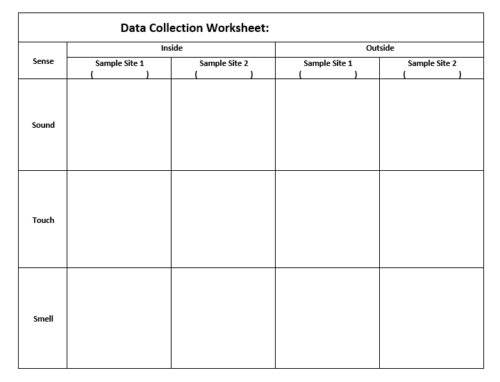
Now you are going to begin the process of collecting data. Use your senses other than sight — including sound, touch, and smell — to collect data.
Here’s what to do:
- SOUND: In each of your four sample sites, sit quietly for two minutes and count how many different sounds you hear at that site. Record the number of sounds in the appropriate box.
- TOUCH: While sitting in that same spot, reach out with your fingers and touch as many different textures you can. Record that number in the appropriate box.
- SMELL: Finally, use your nose to detect different smells and record this number on your datasheet. Be sure to record your data in the corresponding data box.
Once your data is collected, revisit the software detailed in the TECHNOLOGY section above. Use spreadsheet software to create a chart (or multiple charts) that displays your data. Don’t get discouraged; your spreadsheet design may need to be revised so that your data is displayed in a clear and compelling way. Try displaying the same data as both bar charts and pie charts. Which do you like better? Why?
Get PLT’s Explore Your Environment: K-8 Activity Guide
Be sure to check out the full activity, Get Outside!, found in PLT’s Explore Your Environment: K-8 Activity Guide.
- Purchase a print guide or e-book, available from PLT’s Shop, Amazon, and other places where books are sold.
- Get it through your PLT State Coordinator along with hands-on professional development, alignments to state standards, and other state-specific supporting resources.
The post STEM: Get Outside appeared first on Project Learning Tree.
]]>The post Fatima’s Great Outdoors appeared first on Project Learning Tree.
]]> Fatima’s Great Outdoors
Grades 3-5
Written by: Ambreen Tariq
Illustrated by: Stevie Lewis
Published by: Kokila, an imprint of Penguin Random House, 2021
ISBN-13: 978-1984816955
Recommended Reading
Do you remember your first ever camping trip? Are you still planning it? Fatima’s Great Outdoors follows the story of Fatima and the Khazi family, comprised of a father, mother, and an older sister in their first tent camping trip together. This story underscores the many ways in which the natural world offers a loving home to us all.
This endearing book for young readers also offers an introduction to the experiences of immigrants in the United States. Venturing into camping for Fatima and her family is a step into the unknown, just like immigrating to another country can be as well. Throughout the 40 vibrant and colorful pages, readers find themselves rooting for the little girl and her adventurous family.
Readers of all ages will enjoy this story as they remember memories of trips taken with their own kin.
Use Fatima’s Great Outdoors to:
Explore Cultures
The Khazi family introduces readers to some diverse cultural perspectives. Enjoy learning about them through Fatima’s eyes. For example, readers get insight into:
- Living in India – These experiences are conveyed by juxtaposing the parents’ upbringings with the confidence Fatima builds through camping.
Readers see depictions of Mama’s rural hometown and are introduced to the music of Rafi, a famous singer in India.
- Practicing Islam – Though the text does not explicitly name the family as Muslim, naming conventions and cooking practices offer clues that support this religious background. Try to discern what and how these practices connect to the beliefs of the nearly 2 billion practicing Muslim people worldwide.
- Speaking Urdu – The Khazi family speaks Urdu, a language that is related to Hindi. Readers are introduced to Urdu words that are not defined in the text or with a glossary. This prompts readers to rely on context clues to discern meanings.
Terms include Nani (maternal grandmother), Apa (older sister), shabash (word of encouragement), roti (bread), shami kebabs (pan-fried beef patties), samosas (savory fried pastry), aanda (fried egg), and ghee (clarified butter).

- Growing up Brown – In addition to authoring Fatima’s Great Outdoors, Ambreen Tariq is the founder of the social media initiative @BrownPeopleCamping. The last page spread of her book illustrates a group of campers with a sign carrying the same name. The Brown People Camping initiative seeks to use storytelling to promote diversity in the outdoors.

Learn About America’s Parks
While not explicitly named in the text, Fatima and her family visit Emerald Bay State Park. Emerald Bay is located in the state of California, inside Lake Tahoe, near the Nevada-California border. While National Parks are America’s largest and most renowned, the park system operates other entities under a variety of names, including state parks, national and state forests, national grasslands, landmarks, monuments, historic sites, scenic rivers, fish hatcheries, wildlife areas, and more. Use the findyourpark.com website to search by state and discover a park near you.
Create Storyboards
A four-paneled, comic-style spread is used at the beginning and end of Fatima’s Great Outdoors to reflect Fatima’s feelings of distress at school, as well as feelings of freedom, happiness, and belonging that she finds in nature. Fold a single sheet of paper into four quadrants and use your own experiences and creativity to depict an event or series of emotions in a four-paneled storyboard spread of your very own. If you like this exercise, explore more fun you can have with storytelling using a storyboard approach.

Meet the Author
The Outdoors Alliance for Kids (OAK) is a national strategic partnership of businesses and organizations with a common interest in connecting kids and families with the outdoors. In celebration of Earth Month this year, OAK hosted Ambreen Tariq for a FacebookLIVE event that featured a read-aloud of Fatima’s Great Outdoors, followed by a question-and-answer session. Check out the entire 60-minute installment on Facebook, or fast forward to the read-aloud near timestamp 4:30.
Plan a Camping Adventure
In the United States, the National Parks Service offers helpful resources on “How to Camp.” Visit their website to review what to bring, what to do once you get there, visitor etiquette, and safety concerns, among lots of other great information. In Canada, a program called Learn to Camp is offered by Parks Canada. Learn to Camp presents at libraries and other organizations to instruct potential campers on how to plan, organize, and do everything related to camping.
Consider using this book with the following activities from PLT’s Explore Your Environment: K-8 Activity Guide to explore the benefits of outdoor recreation and storytelling:
- Get Outside!
- My Green Future
- Poet-Tree
- Trees for Many Reasons
- Our Federal Forests
The post Fatima’s Great Outdoors appeared first on Project Learning Tree.
]]>The post Socially-Distanced PLT Activities for Summer Camps appeared first on Project Learning Tree.
]]>Why turn to PLT during the summer? Explore Your Environment activities are:
- Fun
- Easy to use and implement
- Flexible in complying with social distancing guidelines
They are also educational, but let’s circle back to “fun!” After this past year, kids need a way to safely connect with friends and enjoy what they are doing, learning, and creating. While PLT is relevant anytime, it is perfect for the summer of 2021.
 How to Start?
You may already know that Explore Your Environment offers 50 field-tested, hands-on activities that integrate investigations of nature with science, language arts, and other subjects. The guide is fresh, user-friendly, and works indoors and outdoors.
Whether you already know the guide, or if this is your first experience, I suggest starting with the “At-a-Glance” Index on pages 420-421 to use PLT in a summer setting. Have a look at the “ICONS” section and identify activities that are exemplars in three areas that benefit summer camps: “OUTDOORS” “NONFORMAL,” and “STEM.” If youth are attending your camp for an extended timeframe, the “LONGTERM” activities are also helpful to check out.
Here’s what these icons mean for your planning:
 The OUTDOORS icon is found on 20 activities. These activities require an outdoor setting to meet the learning outcomes.
 The NONFORMAL icon is found on 25 activities in the guide. These activities work especially well in nonformal education settings – like summer camps!
 The STEM icon is found on 20 activities in the guide. These activities are science-technology-engineering-and-math exemplars, great for the many summer programs with this focus. These activities combine all 4 subject elements while engaging students in problem-solving.
 13 activities in the guide feature the LONGTERM icon. These activities work well in timeframes extended beyond two 50-minute periods of instruction, so if you have the same campers for a week or more, you may want to thread these activities into their experience.
How to Choose?

Okay, you are probably thinking, that still is a lot of activities to decide between. When reviewing the activities, consider your campers and location. I recommend the following:
- Identify activities where students are physically active and manipulating objects over researching or other important but more sedentary activities.
- Identify rainy-day options. It’s always good to have an arsenal of high-quality indoor activities for inclement weather.
- Identify the most active simulations to focus on fun while still maintaining adequate safety spacing.
- Depending on the guidelines in your community, consider the top 8 activities that we have found most appropriate for socially distancing.
PLT activities are organized by grade band (K-2, 3-5, 6-8), although we offer suggestions for how to adapt most of them for younger or older kids. This is especially important in summer programs that may have more fluid age groupings.
As examples, here are three activities—one for each grade band—that check off a lot of the “must-have” summer camp boxes: Have Seeds Will Travel (Grades K-2), Get Outside! (Grades 3-5), and Nature’s Skyscrapers (Grades 6-8).
 Have Seeds, Will Travel is a great STEM exemplar with an engineering design challenge. While it has outdoor components, the “design a seed challenge” works great at an indoor activity station or even on a rainy day. You could also pre-collect seed samples for a successful activity station if needed.
 Get Outside! is a brand new, very physical activity that connects being outside to healthy lifestyles. Consider using this one after a camp lunch or snack break to get youth moving again. It’s also a great one to pull out if attention is waning and you need to get up and get moving to prompt engagement.
 Nature’s Skyscrapers is a great activity to help older kids with math in a fun way. Kids don’t even realize they are doing fractions, equations, and calculations as they are trying to determine tree height in creative ways. You can also adapt this activity indoors, such as by measuring the height of a basketball hoop in a gym or exposed air vents high up on the walls. Nature’s Skyscrapers is also a great activity to connect to green careers. For help making those connections, download the Career Corners at plt.org/myk8guide (brief, free login required). You can also check out more Career Fact Sheets at plt.org/workingforforests.
How to Access the Guide This Summer?
 PLT’s state programs offer not only the guide but also lots more resources to help modify and adapt PLT content for your unique setting. When you contact your State Coordinator, you will also be connected with professional development, networking, and other support available in your community.
You can also purchase the guide directly through shop.plt.org.
And for those of you who will be using PLT back at school in the fall, asynchronous professional development on the new Explore Your Environmental: K-8 Activity Guide will be available for back-to-school in August of this year.
In the meantime, happy summer with PLT!
The post Socially-Distanced PLT Activities for Summer Camps appeared first on Project Learning Tree.
]]>The post PLT’s Top 8 Socially-Distanced Activities appeared first on Project Learning Tree.
]]>- Outdoors only or able to be conducted indoors with one person per table or 6-foot space between people.
- No materials sharing.
- Limited group work.
Although we have arranged them by grade band, remember that they can easily be adapted up or down, especially in non-classroom settings with mixed ages.
Grades K-2
- The Closer You Look – Each participant draws a tree from memory and then draws an actual tree outside. As a group, discuss what participants observed through the activity.
- Have Seeds Will Travel – Each participant gets a plate of different seeds and classifies them in as many different ways as they can. As a group, discuss the different means of classifying. Talk about the design challenge of modifying a bean seed to stick to a plush toy or puppet, or the design challenges in the 3-5 Variation. If comfortable, you could provide different materials for participants to actually do one of the challenges, but it would likely require sharing materials.
Grades 3-5
- Discover Diversity – Each participant has their own study plot to explore, using their own student page. After finding life on their plot, they could share with another participant what they found.
 Get Outside! – Each participant can measure their own heart rate and mood (using either student page) both inside and outside after doing the same task in each location.
- Tree Cookies – Each participant gets their own tree cookie, finds the different parts and determines its age. Then, they draw their own tree cookie showing important events in their life.
- Tree ID – To prep, presenter creates a Tree ID sheet for the site. Each participant looks at their own assortment of leaves and sorts them in different ways. Presenter shares some of the leaf features used to identify different trees. Then, participants visit trees outside and identify them from the ID sheet.
Grades 6-8 
- Living with Fire – Presenter introduces the Fire Triangle, then does Part B as a demonstration outside. Participants do individual wildfire safety checks of the site, using the checklist.
- Nature’s Skyscrapers – Participants measure the height and width of trees outside using their own tape measure and/or ruler. They may each measure their own tree, or do the measuring sequentially.
 Get the Activities
Purchase PLT’s Explore Your Environment: K-8 Activity Guide from Shop.PLT.org, Amazon, and other places where books are sold.
Or, find out about training opportunities in your state.
State PLT programs offer in-person and virtual professional development. Through these interactive (and fun) workshops, participants can receive a print or online copy of Explore Your Environment and practice how to use PLT materials while also gaining insights from the facilitator and each other related to content and teaching strategies.
The post PLT’s Top 8 Socially-Distanced Activities appeared first on Project Learning Tree.
]]>